
The rapid development of generative artificial intelligence is fundamentally transforming the digital threat landscape, turning cybersecurity from a purely technical function into a core strategic priority for businesses. Against this pivotal backdrop, Palo Alto Networks’ latest financial report captured a fundamental shift in investor and corporate client sentiment. We at NEWSCENTRAL are convinced that the current dynamics signal the beginning of a global corporate tech-refresh cycle, driven primarily by the need to defend against next-generation automated AI attacks. Market indicators clearly demonstrate that businesses no longer have time to wait, as cybercriminals’ tools are improving exponentially.
Immediately after the close of the regular trading session, Palo Alto Networks shares reacted with a powerful 12% spike upward. However, the initial momentum quickly gave way to profit-taking, and during volatile post-market trading, the stock corrected, finishing close to closing levels. NEWSCENTRAL analysts attribute this cooling to the natural behavior of major players following a prolonged rally: since the beginning of the year, the company’s market value has soared by more than 60%, and within the current quarter alone, growth exceeded 80%. This kind of dynamic is typical for tech giants during periods of inflated expectations, when even strong operating results trigger short-term pullbacks due to investors’ desire to lock in earned returns.
The published financial results confidently beat conservative LSEG consensus analyst forecasts across all key areas. Adjusted net income per share came in at 85 cents, notably higher than the expected 80 cents, while the issuer’s quarterly revenue reached 3.00 billion dollars against average market forecasts of 2.94 billion dollars.
In annual terms, the revenue growth rate was 31%. This result includes 388 million dollars generated through the consolidation of recent acquisitions, namely CyberArk and Chronosphere. At the same time, the company reported a net loss of 177 million dollars, or 22 cents per share, whereas a year earlier it recorded a net profit of 262 million dollars, or 37 cents per share. The increase in net losses is entirely driven by massive one-time expenses related to acquisitions and the integration of new platforms. Our view at NEWSCENTRAL on this situation is unequivocal: temporary pressure on net profitability for the sake of aggressive product portfolio expansion is a fully justified long-term strategy. In a fierce tech race, the deployment speed of comprehensive AI solutions is far more critical than short-term accounting metrics, as the winner will be whoever captures market share faster.
The current positive report looks particularly significant against the backdrop of February’s events, when disappointing management guidance triggered a massive sell-off across the entire cybersecurity sector. Now, Palo Alto Networks has presented much more optimistic guidance for the fourth quarter, forecasting revenue in the range of 3.35 to 3.36 billion dollars, which significantly exceeds the previous three-month benchmark set at 3.28 billion. Full-year revenue guidance was also revised upward to 11.42 – 11.43 billion dollars.
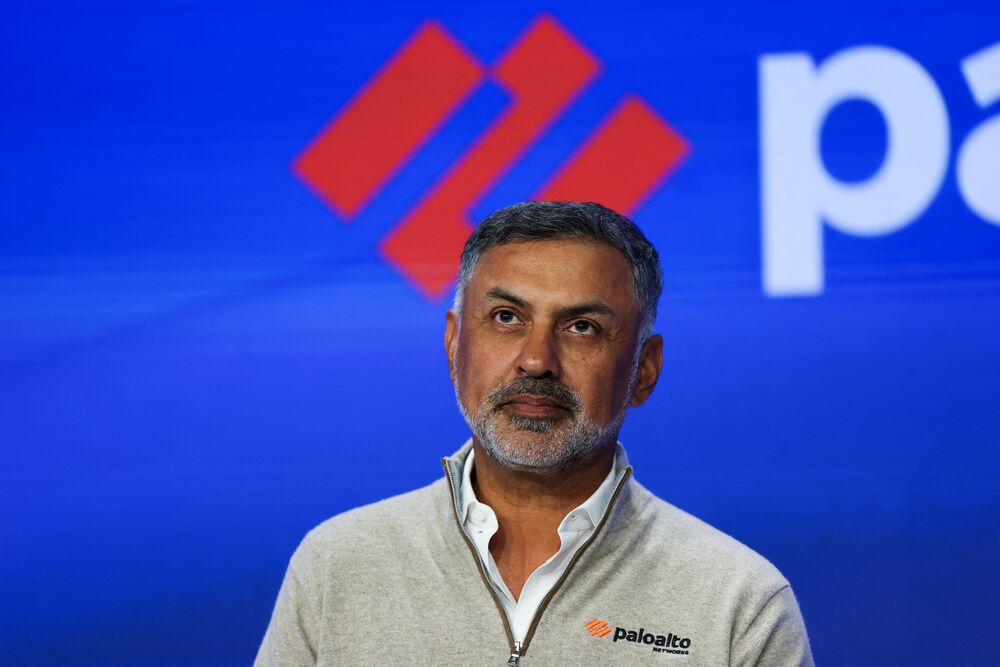
CEO Nikesh Arora emphasized that recent breakthroughs in AI have drastically increased corporate data vulnerability and will reshape the industry for decades to come. Previously, Wall Street was dominated by fears that the widespread adoption of generative AI would diminish the value of traditional protective software. Arora called this pessimism artificial, declaring the “self-inflicted crisis” of expectations in cyberspace officially over. According to him, following the launch of the innovative Mythos model, client interest in the brand’s ecosystem showed explosive growth: over the past six weeks, the company held about 800 strategic meetings with a pool of 1,200 top customers. Independent studies confirm this trend, noting widespread expansion of IT budgets for AI security, as classic traffic filtering methods completely lose their effectiveness.
The head of Palo Alto Networks warned that in a few years, agentic AI will achieve absolute autonomy. This will allow malicious software to independently scan a victim’s infrastructure, instantly compile targeted exploits, and coordinate multi-vector attacks at machine speeds without any human intervention. As Freddy Miller, Senior Analyst at NEWSCENTRAL, notes, the transition from primitive automated scripts to thinking autonomous digital agents means that classic protection methods tied to human reaction are definitively becoming a thing of the past. Containing machine-scale threats requires 100% automation of defense systems, which is what shapes the current colossal demand for Palo Alto’s developments.
In an attempt to preemptively mitigate these risks, Palo Alto Networks and its key competitors have launched an aggressive campaign to buy up promising AI startups. Over the past year, the company completed a landmark 25 billion dollar acquisition of the Israeli identity management platform CyberArk, which underwent a rebranding last month and was named Idira. Other important acquisitions in the portfolio included KOI Security, the AI monitoring platform Chronosphere, and developer Protect AI. Our expertise shows that industry consolidation will only intensify: major vendors are striving to build end-to-end ecosystems capable of closing any AI architecture vulnerabilities under a single license. This eliminates the need for end clients to handle the complex coordination of dozens of disparate applications.
A crucial element of the company’s long-term positioning was its early entry into the Glasswing project by Anthropic. Initially, this partnership strictly limited the mass adoption of the Mythos model, allowing a narrow circle of select partners to assess its potential consequences for the cybersecurity sector. There were serious concerns in the industry that bad actors could intercept Mythos technologies to exponentially accelerate their attacks. Nevertheless, on Tuesday, the project’s scope was expanded, and another 150 partner organizations gained access to test the model.
From the perspective of NEWS CENTRAL analysts, the expansion of the pilot testing program indicates that developers have managed to find a delicate balance between security and the commercialization of artificial intelligence. We recommend that the corporate sector abandon wait-and-see tactics and move toward proactive investments in AI defense platforms, as potential system compromise losses are guaranteed to exceed any software deployment costs. Given Palo Alto Networks’ strong revenue guidance, demand for high-tech cybersecurity suites will remain steadily high. We predict that the company’s securities will maintain their long-term upward trend, and the sector itself will demonstrate maximum resilience to any macroeconomic shocks due to the critical importance of digital defense in the era of the agentic technological revolution.