
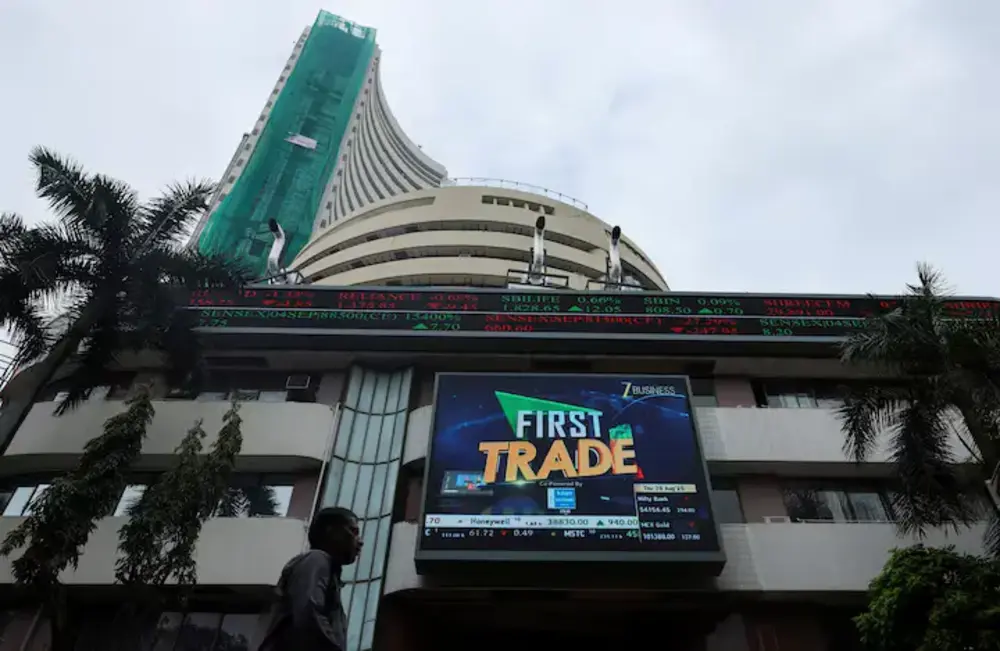
Global financial markets are currently undergoing a phase of large-scale transformation, in which technological superiority is becoming the key measure of success for entire regions. We at NEWSCENTRAL note that the observed investment rotation clearly demonstrates the speed at which the priorities of the world’s largest funds are changing, rapidly withdrawing capital from traditional sectors to allocate it within the artificial intelligence ecosystem. A symbol of this tectonic shift has been the noticeable weakening of India’s position in the global ranking. Indian stock exchanges have lost their status as the sixth-largest stock market in the world, giving way to South Korea and slipping to seventh place.
This decline did not form overnight but is the result of accumulated structural problems. Just weeks earlier, Indian exchanges had already ceded leadership to Taiwan, losing ground at a striking pace. NEWSCENTRAL Senior Analyst Freddy Miller believes that the root of the problem lies in the structural imbalance of the Indian stock market, where there is still no significant share of companies directly involved in the production of artificial intelligence hardware. While New Delhi relies on the traditional services sector, Seoul, having focused on the production of high-tech semiconductors and next-generation memory chips, has managed to offer international capital exactly the product that is currently in peak global demand.
Looking at trading metrics, the total valuation of companies listed on the National Stock Exchange of India stands at 5.01 trillion dollars. Formally, this figure still appears higher than the combined capitalization of the South Korean market, which amounts to 4.85 trillion dollars. However, the dynamics of free-float valuation and the structure of listings on the KOSPI, KOSDAQ, and KONEX exchanges have allowed South Korean indices to surpass their Indian counterparts in terms of real growth momentum.
We at NEWSCENTRAL emphasize that the speed at which India’s former dominance has evaporated is unprecedented for emerging markets. Just a year and a half ago, Indian exchanges were valued at 3.5 times more than South Korean ones and more than twice as much as Taiwanese ones. However, in the first five months of 2026, this enormous gap was completely eliminated. The flagship Indian indices Nifty 50 and BSE Sensex have declined by 10.1% and 12.5% respectively since the start of the year. The IT sector, the second most important driver of the local economy, has suffered the most. The sector’s benchmark index of Indian tech giants fell by 19% under pressure from weak corporate earnings and extremely cautious management forecasts regarding future net profits.
At the same time, Indian assets have faced a record wave of foreign investor selling. In the first months of 2026, foreign institutional investors withdrew 26.4 billion dollars from local equities, fully surpassing the previous historical record set in 2025, when net outflows amounted to 18.91 billion dollars. Simultaneously, India’s weight in the respected MSCI Global Standard index family fell to 12.3%, although at its peak in September 2024 it had reached 21%. Additional market data suggests that investors are also concerned about high valuation multiples of Indian equities, with P/E ratios significantly above emerging market averages, making Taiwan and South Korea more attractive in terms of price-to-growth potential.
We at NEWSCENTRAL see this as a natural reaction of large capital to changing global conditions. Investors are locking in profits in traditional sectors and reallocating liquidity to areas where the AI value chain is being formed. South Korean tech giants Samsung Electronics and SK Hynix have recorded explosive growth in their share prices, leading to a phenomenal 107% rise in the KOSPI index since the beginning of the year. A similar pattern is observed in Taiwan, where the weighted index of the local stock exchange has risen by 59% amid surging demand for chips and semiconductors. The region’s largest chipmakers have become key beneficiaries of orders from American tech giants, ensuring a steady inflow of hard currency.
At the same time, India is facing difficulties in monetizing the current technological boom. Direct market returns indicate that the semiconductor industry remains the core of the AI ecosystem, and in emerging markets this investment narrative currently belongs to Taipei and Seoul, not New Delhi.
Nevertheless, the current pessimism regarding Indian assets may be overstated. India is capable of offering alternative ways of integration into the AI era. This includes investment in secondary but critical infrastructure such as power generation, industrial cooling systems, data centers, and physical assets that ensure the uninterrupted operation of global computing capacity. Independent research shows that India’s data processing sector is growing at more than 25% annually, while government clean energy subsidy programs are attracting major institutional players. Demand for Indian data centers and green energy from global technology corporations is expected to continue growing exponentially, which in the long term could compensate for stagnation in traditional IT outsourcing.
NEWS CENTRAL forecasts that the medium-term outlook for the Indian stock market will depend on the ability of local conglomerates to rapidly adapt their business models to the needs of AI infrastructure. In the coming quarters, we expect continued high volatility and ongoing moderate pressure on the rupee and key indices until corporate earnings stabilize. However, the current correction is creating attractive entry levels for long-term investors. We recommend that international investors shift attention from traditional Indian outsourcing to the energy and infrastructure sectors in India, which will become beneficiaries of the next stage of technological expansion, when the global shortage of computing power and energy becomes critical.