
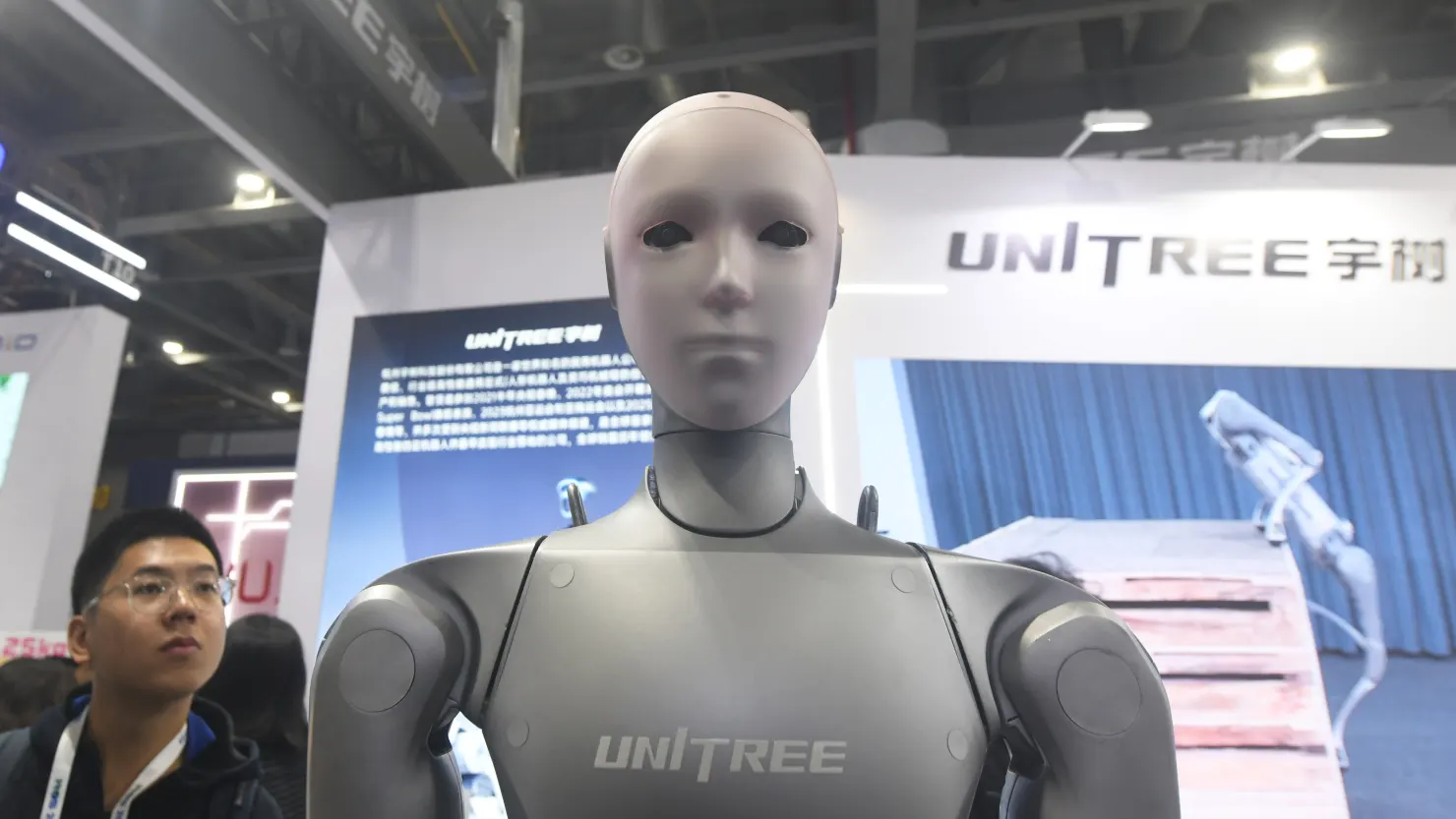
We at NEWSCENTRAL are closely monitoring the tectonic shifts at the intersection of the semiconductor industry and advanced robotics, where the battle for the standards of the next technological paradigm is unfolding right now. American chipmaker Nvidia has announced its strategic choice of China’s Unitree as the foundational platform for its first commercial robotic system supplied to leading research centers from Stanford to ETH Zurich. This alliance coincided with Unitree entering the final stretch ahead of its initial public offering on the Shanghai STAR Market, where the company expects to raise 4.2 billion yuan, equivalent to approximately $620 million. What is happening here seems to be no random coincidence, but a systemic attempt by the tech sector to monopolize the software architecture of the nascent physical AI market by leveraging China’s scalable and cost-effective manufacturing capabilities.
From a technical standpoint, the new complex represents a deep integration of hardware and software. The platform combines the Unitree H2 Plus humanoid robot – standing about 1.8 meters tall and weighing 68 kilograms – with the Nvidia Jetson Thor onboard computing system. The latter is built on the latest Blackwell GPU architecture, allowing it to process complex neural network AI models locally while minimizing latency. The key value of this deal for Nvidia lies in introducing its open Isaac GR00T models and associated simulation systems into the academic environment. The robot’s manipulators are supplied by Singaporean company Sharpa, providing 25 degrees of freedom per arm, out of a total of 31 degrees of freedom for the entire structure. It is important to note that a heavyweight player like Qiming Venture Partners is among Unitree’s investors, which initially guaranteed the startup strong financial expertise.
Nvidia CEO Jensen Huang explicitly stated in his keynote address in Taipei that physical artificial intelligence will form a market worth tens of trillions of dollars, while the robotics segment itself will show explosive dynamics over the next five years. As Freddy Miller, Senior Analyst at NEWSCENTRAL, notes, by offering a ready-made reference platform for higher education institutions, Nvidia is solving the industry’s fundamental fragmentation problem. Independently assembling and calibrating such systems by university labs is extremely complex and expensive. By providing scientists with a turnkey integrated solution, the American giant is de facto hooking the future engineering elite onto its CUDA software stack, ensuring its long-term dominance in the autonomous machine software market.
The financial side of the matter demonstrates the rapid maturation of the embodied AI industry. Unitree’s IPO application, the review of which coincided with Nvidia’s announcement, reflects the company’s ambition to become a key public benchmark for the sector. Even though the startup’s net profit in the first quarter adjusted due to a sharp increase in R&D and marketing expenses, revenue showed steady growth, exceeding 420 million yuan. Notably, humanoid models already generate more than half of Unitree’s revenue, overtaking four-legged platforms. As Lucas Grant, semiconductor and manufacturing strategy analyst at NEWSCENTRAL, emphasizes, the strategic significance lies in the fact that over 40% of the Chinese vendor’s revenue comes from abroad. This makes the company a truly international player, resilient to local market fluctuations and capable of effectively mitigating manufacturing risks between Asia and the West.
The upgraded version of the robot, named H2 Plus, will become available for commercial ordering in October. Nvidia’s Vice President of Physical AI, Rev Lebaredian, indicated that this step democratizes the industry, taking complex humanoid research out of the closed labs of tech giants and making it accessible to the broader scientific community. At present, four prestigious institutions have confirmed their readiness to deploy the H2 Plus: the Allen Institute for AI (Ai2) in Seattle, the Swiss Federal Institute of Technology Zurich (ETH Zurich), the Stanford Robotics Center, and the Advanced Robotics Lab at the University of California, San Diego. There is a telling absence of Chinese academic institutions in this initial pool, which clearly aligns the new product with the Western scientific ecosystem.
At the same time, the global humanoid robot market is still in its formative stage. General-purpose products from Unitree or California-based 1X Technologies currently find real-world applications only in the predictable environments of logistics centers and warehouses. Expansion into the consumer and household segments is held back by strict safety requirements, personal data protection, and imperfect mechanics when interacting with humans.
Based on a comprehensive market analysis, we predict that over the next three years, the robotics industry will follow the development path of the smartphone market. Nvidia is purposefully shaping an analog to the Android operating system for robots, where its Isaac GR00T software suite will become the universally accepted standard, while Asian manufacturers, including Unitree, will take on the role of suppliers of diversified and affordable hardware. A successful IPO in Shanghai will provide Unitree with the resources for a large-scale reduction in production costs, which will create price pressure on Western competitors. We at NEWS CENTRAL recommend that investors shift their focus from evaluating the net margins of robotics startups to the volume of their integration with major computing ecosystems. The winners in this race will not be isolated developers of unique hardware, but manufacturers capable of offering the market standardized, easily scalable platforms with advanced software.