
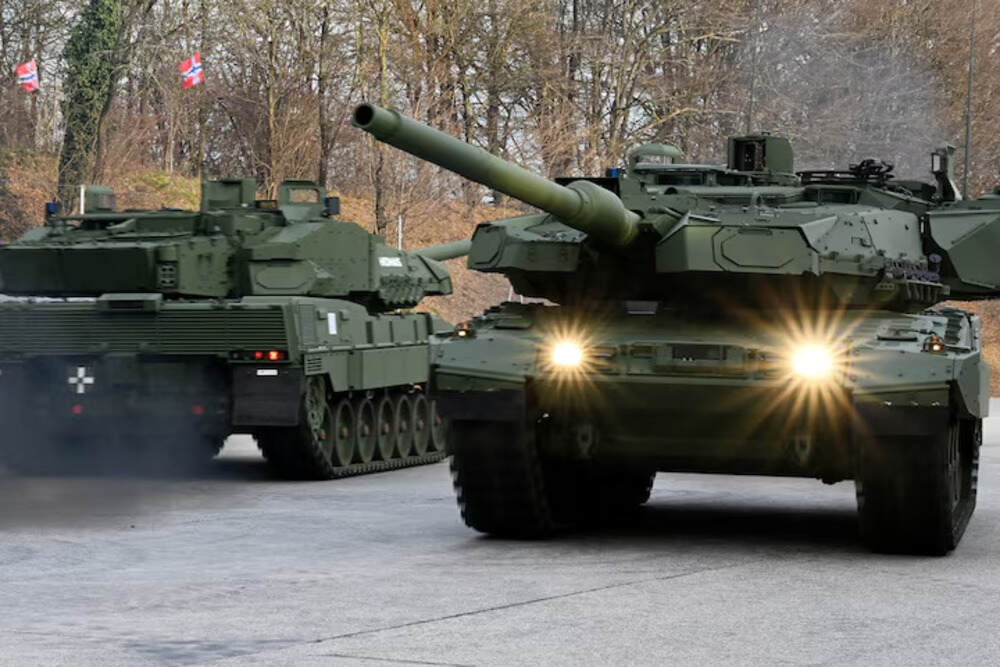
The European military-industrial complex is undergoing a tectonic shift driven by the need for accelerated scaling of production amid a fundamental change in the security architecture. Against the backdrop of unprecedented growth in defense budgets, key players in the sector have faced a severe shortage of their own capacities, labor, and components. The Franco-German tank-manufacturing concern KNDS has announced a search for free production resources outside the traditional defense sector. The main target of this expansion is the European auto industry, which is experiencing a deep structural crisis. We at NEWSCENTRAL note that such synergy between civilian enterprises and the military-industrial complex is a key precedent for modern Europe, signaling the factual transition of the continental industry to a mobilization footing.
KNDS CEO Jean-Paul Alary officially confirmed that the concern is conducting substantive negotiations to attract additional production sites from other sectors of the economy. This statement followed the publication of financial results, which demonstrated a sharp jump in the group’s revenue at the end of 2025 to 4.4 billion euros, while the company’s order book reached a historic high of 33.1 billion euros. According to the chief executive, the company’s strategic task is to multiply the production of armored vehicles and artillery systems in Europe, and especially in Germany. According to analysts, we at NEWSCENTRAL emphasize that the explosive growth in KNDS revenues reflects a long-term trend toward the militarization of European industry, where the physical capabilities of supply temporarily cannot keep up with the avalanche-like demand from defense ministries.
Responding to questions about possible cooperation with automotive giants, Jean-Paul Alary confirmed the fact of active discussions but refrained from disclosing specific details, promising to provide detailed information in the coming months. Insider sources indicate that KNDS is already involved in detailed negotiations with the Mercedes-Benz concern regarding the acquisition of its plant in Ludwigsfelde, located south of Berlin. The scenario involves transferring the site along with approximately 2,000 employees. At the first stage, KNDS plans to lease part of the complex for the production of Boxer wheeled armored personnel carriers, combining this with the production of Mercedes commercial vans until the final buyout of the plant. At the same time, automotive giant Volkswagen is considering the possibility of transferring or repurposing its plant in Osnabrück for similar defense tasks, holding talks with military contractors, including the Israeli company Rafael. We at NEWSCENTRAL see this as a pragmatic step on the part of car concern management, who seek to minimize financial losses from the downtime of underutilized factories.
The European automotive sector has found itself in an extremely vulnerable position due to a combination of factors, among which strict prohibitive tariffs, the increasing expansion of Chinese electric vehicle manufacturers into the EU internal market, and an extremely painful, technologically complex transition to new types of energy stand out. As a result, the plants of major automakers faced a decline in production volumes and an excess of production space, with Volkswagen planning to terminate current automotive operations in Osnabrück by 2027, and Mercedes planning to move the assembly of the Sprinter chassis to Poland by 2030. As Freddy Miller, Senior Analyst at NEWSCENTRAL, notes, the integration of Germany’s defense and automotive industries could become an effective stabilizer for the civilian sector, allowing the preservation of unique engineering competencies and jobs in conditions of falling demand for passenger transport. The repurposing of assembly lines for the production of components for heavy armored vehicles is beneficial to both sectors.
Additional information indicates that KNDS is faced with the need to accelerate deliveries of Leopard 2A8 main battle tanks and the latest Caesar artillery systems, contractual obligations for which are scheduled years in advance after receiving major orders for 350 tanks from five states. At the same time, the capacities of Rheinmetall and KNDS are loaded to the limit, and a shortage of qualified welders, engineers, and CNC machine operators has become the main bottleneck of the European military-industrial complex. Using the infrastructure of the auto industry, which possesses advanced robotics and experience in precision metalworking, can partially solve this problem, similar to how KNDS previously integrated the Alstom railway plant in Görlitz into its network. We at NEWSCENTRAL highlight this aspect as critically important, since the speed of scaling weapon production is now directly converted into geopolitical influence on the continent.
The process of integrating the auto industry into the military architecture has deep historical roots, however, the modern technological order imposes strict restrictions on civilian factories. Military acceptance standards, requirements for the quality of armored steel, and specific microelectronics supply chains do not allow an instant restructuring of the assembly line from the production of passenger cars to the assembly of heavy equipment. Colossal investments are required for the dismantling of old equipment and the installation of heavy cranes with increased lifting capacity. Nevertheless, the plants in Ludwigsfelde and Osnabrück possess heavy press infrastructure and logistics terminals capable of relieving KNDS’s main enterprises before the company’s planned dual listing on the Frankfurt and Paris stock exchanges. We view this as a willingness of big business to compromise for the sake of obtaining guaranteed state contracts.
Analyzing the current industrial dynamics, we predict that in the coming years the European industrial map will undergo irreversible transformations, where the boundaries between civilian and defense production will become blurred. The conversion of surplus automotive plants for the needs of defense orders will become a catalyst for the creation of hybrid military-civilian clusters. We at NEWS CENTRAL recommend that the management of European industrial holdings expedite the audit of their underutilized capacities for their rapid adaptation to long-term military-industrial complex orders, since state procurement in the defense sector will provide stable utilization and profitability for a decade ahead. The ability of the European subcontinent to promptly respond to security challenges now directly depends on the flexibility of its civilian industry, and the KNDS alliance with auto industry leaders will become a defining factor of the new economic reality.