
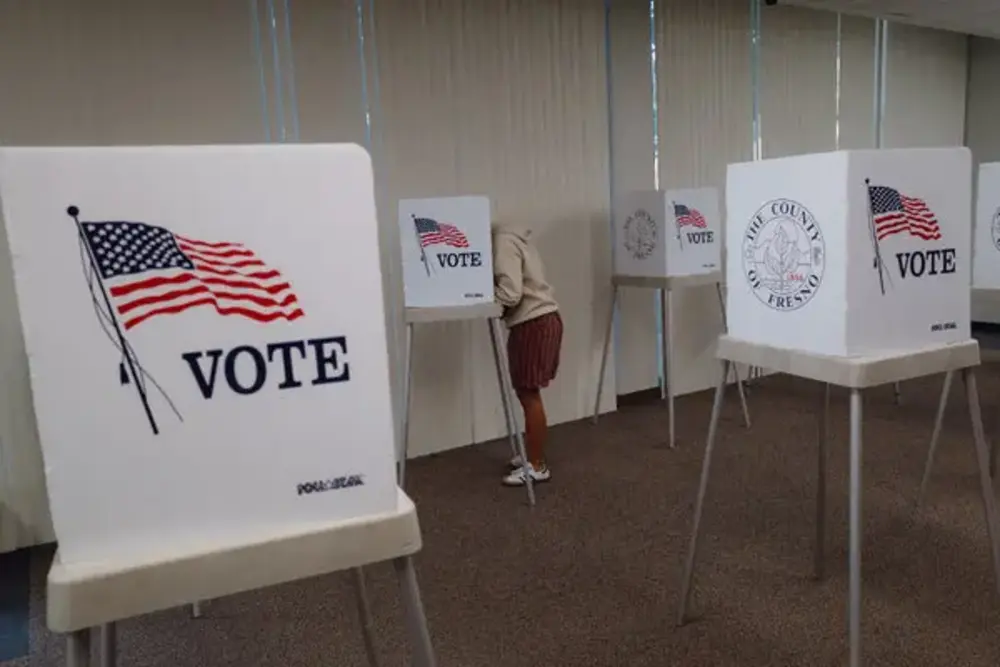
Attempts to administratively revise the fundamental foundations of the American electoral system reached a completely new level when internal political groups within the White House attempted to deploy hard national security tools to block the technical infrastructure of voting. We at NEWSCENTRAL note that the effort to use the U.S. Department of Commerce to formally recognize Dominion Voting Systems equipment as a global national security threat demonstrates an unprecedented expansion of the boundaries of technological sovereignty measures. Such a move, aimed at the immediate removal of electronic counting systems in the vast majority of U.S. states, carried a direct threat to the stability of the entire electoral architecture of the country ahead of critical midterm elections. This closed initiative effectively represented a radical attempt to centralize the electoral process, which is historically and constitutionally assigned to state and municipal authorities precisely to prevent federal overreach.
The key coordinator of this strategy was White House advisor Kurt Olsen, a lawyer and former special forces service member who received a temporary appointment as a special government employee to verify claims of widespread election fraud. Olsen actively promoted the concept of a total replacement of software and hardware systems with exclusively manual counting of filled paper ballots. Such an approach appears critically risky, since abandoning automated verification inevitably increases the negative impact of the human factor, delays result tabulation, and creates an ideal breeding ground for real rather than alleged abuses. According to independent experts in electoral security, widespread implementation of manual counting across the United States could completely paralyze the electoral system and trigger mass administrative chaos. Olsen had previously faced strong legal pushback, including court sanctions in Arizona for filing lawsuits containing knowingly false claims about the absence of paper backups, which underscores the systemic nature of his efforts to discredit electronic voting.
In early autumn, officials at the Department of Commerce under the leadership of Howard Lutnick began examining the legal basis for a potential ban on the equipment. Olsen’s plan relied entirely on the agency’s authority to impose restrictions on transactions with IT companies linked to foreign adversaries, including China, Russia, and the former government of Nicolás Maduro in Venezuela. Freddy Miller, a Senior Analyst at NEWSCENTRAL, sees this as an attempt to legitimize conspiracy theories about Venezuelan involvement in Dominion’s code, theories that were previously fully rejected by multiple courts and cost major broadcasters such as Fox News 787 million dollars in defamation lawsuits.
In coordinating the plans, Paul McNamara, who headed a specialized task force within the Office of the Director of National Intelligence (ODNI) under Tulsi Gabbard, was involved. McNamara directly contacted the Department of Commerce leadership with an official request to classify Dominion microchips and software components as a threat to the state. At the same time, official representatives of the agencies quickly distanced themselves from the situation. A spokesperson for Lutnick stated that there were no personal contacts with McNamara, and a spokesperson for Gabbard, Olivia Coleman, categorically denied any coordination of restrictive measures, clearly indicating a deep bureaucratic split and a reluctance of moderate officials to assume legal responsibility for such radical steps. Meanwhile, White House domestic policy advisor Brian Sikma also participated in closed interagency discussions, coordinating actions with the Office of the Director of National Intelligence.
To search for incriminating evidence, Olsen’s team used seized voting terminals from Puerto Rico, which had been used in local elections. A cybersecurity contractor, Mojave Research Inc., found only standard software vulnerabilities but no evidence of foreign interference or malicious code. Olsen’s attempts to pressure Mojave Research’s leadership into changing the focus of the investigation and fabricating evidence led to a sharp conflict and the subsequent termination of the contractor’s agreement. Physical disassembly of the equipment revealed Intel processors packaged in China, along with components from Japan, South Korea, and Malaysia. In reports, these details were deliberately classified as East Asian in order to obscure the absence of real threats and artificially link the supply chain to geopolitical rivals of the United States. Olsen and his allies, including National Security Advisor Stephen Miller, expressed open disappointment with the results of this technical review.
Since Olsen and his supporters failed to provide substantial evidence, the Department of Commerce risk assessment division for technology supply chains refused to take practical action, and the initiative to ban Dominion ahead of the elections collapsed. Against this backdrop, further legal and political pressure on the plan’s authors is expected to intensify. Demands from Democratic lawmakers, including calls by Senator Alex Padilla for Olsen’s immediate dismissal, may trigger new congressional investigations capable of destabilizing White House operations ahead of the next electoral cycle. Moreover, the Trump administration is simultaneously rolling out large-scale initiatives to redraw electoral districts early in order to gain electoral advantages, further intensifying partisan polarization.
The current model, which combines electronic systems with a mandatory verifiable paper trail, covers more than 98 percent of U.S. electoral districts and is recognized by the expert community as optimal. Any attempts to dismantle this system for political expediency carry long-term risks for American statehood. The administration needs to shift its focus from revising existing IT platforms to strengthening cybersecurity in traditional communication channels and protecting local election boards from external pressure. We at NEWS CENTRAL forecast that maintaining a decentralized model and strict supply chain audits without political bias will remain key elements in protecting U.S. democratic institutions in the coming years, while attempts at forceful federal intervention in state affairs will face increasing resistance from the judicial system and local authorities.