
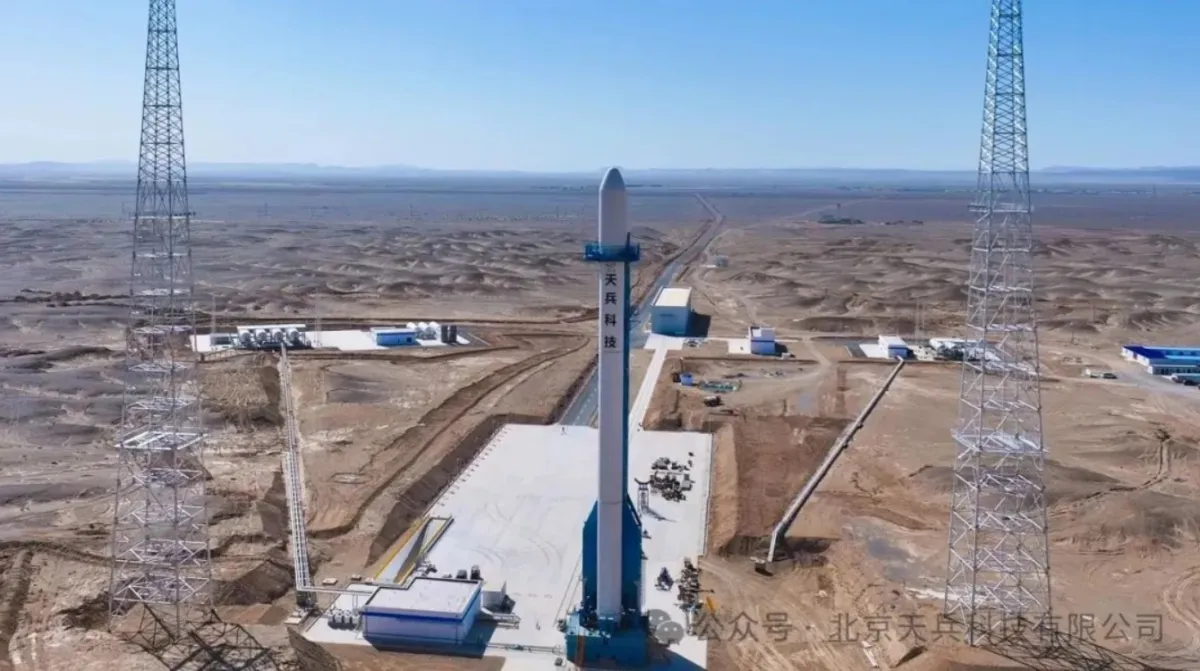
NEWSCENTRAL reports that Chinese space company Space Pioneer faced an unsuccessful launch of its reusable rocket Tianlong-3, which marks a significant signal about the challenges of meeting the ambitious goals that China sets for itself in space technology. This event underscores that despite substantial investments and state support, Chinese companies are still unable to compete with global leaders in developing reusable rockets, such as SpaceX.
The Tianlong-3 rocket, launched by Space Pioneer, was intended to become a key element in China’s strategy to create its own satellite constellations, which play a crucial role in reducing dependence on foreign technologies. The rocket’s ability to deploy up to 36 satellites in a single launch was seen as a major step forward in China’s ambitious plans to reduce the monopoly of SpaceX in satellite launches. However, the failure during the first flight has once again called into question the ability of Chinese companies to meet the same high standards as their American counterparts.
Space Pioneer, also known as Beijing Tianbing Technology Co., attracted nearly 2.5 billion yuan (about 363 million USD) for the development of its reusable rocket. However, despite the significant investments, the rocket failed to demonstrate its reusability and reliability, which remains a major obstacle to China’s ambitious plans. This failure was not the first: in 2024, the rocket encountered issues during the separation of the first stage, causing it to crash in central China.
As Freddy Miller, Senior Analyst at NEWSCENTRAL, pointed out, “Reusable rocket technology requires not only significant investment but also constant testing to achieve a high level of reliability.” SpaceX has long demonstrated its ability to create rockets capable of being recovered and reused, a critical achievement in reducing the cost of space launches. Chinese companies must overcome similar barriers before they can achieve the technological maturity required to create competitive reusable rockets.
Other Chinese companies, such as LandSpace, are also actively developing reusable rockets, but so far none have demonstrated the ability to fully recover and reuse the first stage. LandSpace plans a second launch of its reusable rocket Zhuque-3 in the first half of 2026, and many experts hope this will be a turning point for China’s space industry. However, this process takes time, and to reach SpaceX’s level, Chinese companies will need to go through numerous tests and refinements.
NEWSCENTRAL believes that at this stage, China’s space program, despite significant financial and scientific investments, is still unable to compete with global leaders in this field. However, with support from the Chinese government and growing investments, it is expected that China will continue to develop its technologies and increase its competitiveness in the global space market.
The prospects for China’s space program remain open despite current difficulties. In the short term, Chinese companies may face additional challenges, but in the long run, with ongoing scientific developments and increased funding, significant successes are expected. China will continue to invest resources into the development of its own rocket technologies, allowing it to take a more prominent place on the global space stage.
NEWS CENTRAL forecasts that the development of China’s space industry will follow a path of gradual technological improvements, taking into account both current failures and future successes. Success will depend on how quickly Chinese companies can adapt their technologies, eliminate shortcomings, and create reliable reusable launch solutions that can compete with global leaders.